
What is monthly search volume?
What is monthly search volume?
Monthly search volume (sometimes abbreviated to MSV) is the number of times people searched the keyword during a month. It tells you the keyword’s “search demand”—how popular the keyword is during that month. More popular keywords have higher search demand, and drive more traffic to their top search results because more people search for them.Popularity can change over time. Looking at monthly search volume trends over time can also help you identify seasonal changes, helping you to plan when to publish content ahead of volume spikes. For example, there are more searches for “New Year party napkins” in December than in other months.Currently, in most reports, monthly search volume represents the monthly value averaged across the most recent 12 months. However, when the data is available for a time period, our Keywords report shows an approximate value for the actual number of searches for the keyword during the month—not a 12-month average.
What does the tooltip mean when it says "Data includes 12-month average MSV: awaiting search engine update"
What does the tooltip mean when it says "Data includes 12-month average MSV: awaiting search engine update"
Conductor publishes approximate monthly search volumes for keywords as soon as it has the data collected for the time periods in question. Until that point, the monthly search volume for a keyword reflects an average of the previous 12 months.In the Keyword Details report, you’ll see this indicated by a dashed line and the following tooltip for any affected time periods in the chart:
“Data includes 12-month average MSV: awaiting search engine update”In Keywords, you’ll also see this indicated by the dashed line and the tooltip, but only when at least 10% of the keywords you are reporting on are using averaged search volumes.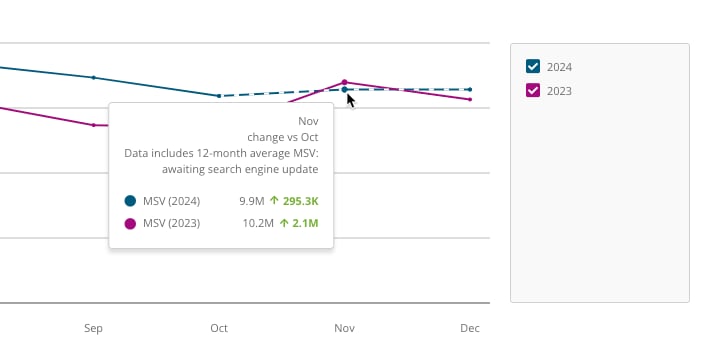
“Data includes 12-month average MSV: awaiting search engine update”In Keywords, you’ll also see this indicated by the dashed line and the tooltip, but only when at least 10% of the keywords you are reporting on are using averaged search volumes.
How do I research monthly search volumes with Conductor?
How do I research monthly search volumes with Conductor?
In reports, you’ll see monthly search volume appear for keywords.To look up a keyword’s search volume, enter a topic in Research, and review the monthly search volume in the Monthly Search Interest widget.
How does Conductor calculate and display monthly search volume?
How does Conductor calculate and display monthly search volume?
By location
This data appears for locations as determined by the report you are viewing in Conductor. For example, a report showing data for New York, NY shows search volumes for New York City. Likewise, a report showing data for the United States shows search volume for the United States.By device
Monthly search volume values always represent keywords performed on all devices. This means a report showing data for San Francisco, CA on desktop will show the same monthly search volume values as for a report showing data for keywords in San Francisco, CA on Smartphone.By source
For keywords you track in Conductor, monthly search volume data comes directly from Google’s Keyword Planner as part of Conductor’s search data publication process.For keywords that appear elsewhere in the platform (for example, the Research report) monthly search volume data comes from Semrush—one of Conductor’s data partners.Monthly Search Volume Trend Graphs
In some reports in Conductor, trend graphs appear to show the most recent 12 months of average monthly search volume values to help indicate seasonal changes in interest.Note that each bar represents a full calendar month of data, averaged across the month— with the most recent full month appearing on the right. For example, If you view the graph on March 30, the rightmost bar represents February (the most recent month with full data) and the leftmost bar represents January from the previous year. If you view the graph a week later on April 6, the rightmost bar represents March and the leftmost represents February from the previous year.Why do monthly search volumes vary within Conductor and compared to other tools?
Why do monthly search volumes vary within Conductor and compared to other tools?
The primary reason search volumes can differ is that Conductor uses two different data sources for two different jobs: one for precise measurement of the keywords you track, and another for broad research on new topics. This approach also explains why our numbers might differ from other tools.
Measurement versus Research: Understanding the Data Sources
The data source we use depends on whether a keyword is being actively tracked in your account:- For tracked keywords in measurement reports: In reports like Keywords and Market Share, Conductor uses search volume data pulled directly from Google Keyword Planner for each individual keyword. This provides the most accurate data for your most important keywords, reflecting the search demand that Google itself sees.
- For untracked keywords in discovery features: In discovery tools like Research, Conductor uses data from our partner, Semrush. Their massive index provides directional insights into the popularity and seasonality of keywords you haven’t tracked yet, which is perfect for research and discovery.
The Challenge of “Close Variants”: Grouped versus Ungrouped Data
A key reason for data differences lies in how “close variant” keywords (like “shoe” vs. “shoes”) are handled.- Grouped Data: When you make requests for monthly search volume (MSV) data for multiple keywords in Google Keyword Planner, Google often returns a single, combined MSV for close variant keywords in your request. It doesn’t specify the volume for each individual term within that group.
- Ungrouped Data: To account for this grouped data, many tools—including Semrush—take Google’s “grouped” volume and use methods like historical clickstream data to estimate the individual search volume for each specific keyword variant. While useful, this is an estimation rather than the actual MSV values for the individual keywords.
Which Search Volume Should I Use?
Ultimately, all search volume data should be used to understand trends rather than as an exact figure. Here’s our recommendation:- For accuracy on core keywords, rely on the data for your tracked keywords. This is Google’s direct data and best represents search demand for measurement.
- For exploring new topics, use the data in our research tools. It provides valuable directional insights to guide your strategy.
Does Conductor report city- and device-specific search volume data?
Does Conductor report city- and device-specific search volume data?
Conductor reports monthly search volume for keywords tracked at the location specificity you are reporting on.However, Conductor does not report on monthly search volume for specific devices.
What is the difference between a monthly search volume value of 0 versus "N/A"?
What is the difference between a monthly search volume value of 0 versus "N/A"?
An explicit value of 0 means that Google reported that no searches were performed. Note that it is possible to rank for a tracked keyword that received little or no search volume. This is more likely for very specific or long-tail keywords.N/A (Not Applicable) means that Google did not report a value for the tracked keyword. Usually, Google limits monthly search volume data to only keywords with:
- No special characters (such as accents or diacritical marks).
- Fewer than 80 characters.
- Fewer than 10 words.
- Conductor may not yet have processed monthly search volume data for them. This might occur based on when you tracked them in your account.
- Google simply has not published monthly search volume data for the keyword, so no value could be assigned in Conductor.
What about monthly search volume for non-Google search engines?
What about monthly search volume for non-Google search engines?
Conductor supports other search engines with their own monthly search volume data:Amazon: Conductor derives and calculates Amazon monthly search volume data from Google Keyword Planner data.Baidu: Baidu monthly search volume data comes from Conductor’s data partner Dragon Metrics. This metric is an average of the daily search volumes from the previous 30 days, multiplied by 30. As a result, this metric updates daily.Daum: Conductor derives and calculates Daum monthly search volume data from Google Keyword Planner data.Naver: Naver monthly search volume data comes from Conductor’s data partner Dragon Metrics. This metric is the sum of the daily search volumes during the month. As a result, this metric updates daily.Yandex: Yandex monthly search volume data comes from Conductor’s data partner Serpstat, and is updated monthly.
Why doesn't Conductor report some of my search volumes?
Why doesn't Conductor report some of my search volumes?
Conductor uses Google data sources to provide monthly search volume values. Because of Google’s policies, they may not provide monthly search volume values for certain keywords related to topics such as weapons, dangerous products, or tobacco. As a result, Conductor cannot display these values in the platform for the relevant keywords.
When can I see monthly search volume data for a keyword I tracked with Conductor?
When can I see monthly search volume data for a keyword I tracked with Conductor?
You can expect that monthly search volume data will appear with rank data for newly tracked keywords in as few as two days—but no later than 14 days. Data for keywords added to Conductor before 5:00 P.M. Eastern on Thursdays appears in Conductor on Monday. Data for keywords added after that time will appear in Conductor after the following time period closes and data is published on the following Monday.