
Getting Started
Overview
Our Reporting API is used for extracting data and metrics from your Conductor Monitoring account. Typical use-cases include connecting several software solutions together to streamline your reporting tasks and integrating Conductor Monitoring in your client portal.This support article is covering the current 2.0 version of Conductor Monitoring’s Reporting API. We recommend using the Reporting API v2.0 for your reporting tasks and integrations as all new endpoints will be only supported on this version.The legacy Conductor Monitoring Reporting API version is still available. You can find the relevant support documentation and our migration guide in the Conductor Monitoring Reporting API V1.0 article.Please note that while the legacy Reporting API v1.0 remains available at the moment, it will likely be deprecated in the future. Therefore we highly recommend using (and migrating to) the Reporting API v2.0.
Reporting API Terms of Use
By using the Reporting API you agree to the Terms of Use.Authentication
Get your API integration token
To use Conductor Monitoring’s Reporting API you need to get your account’s Reporting API token. You’ll find it in the Integration Tokens section under the Account tab in the main Account section.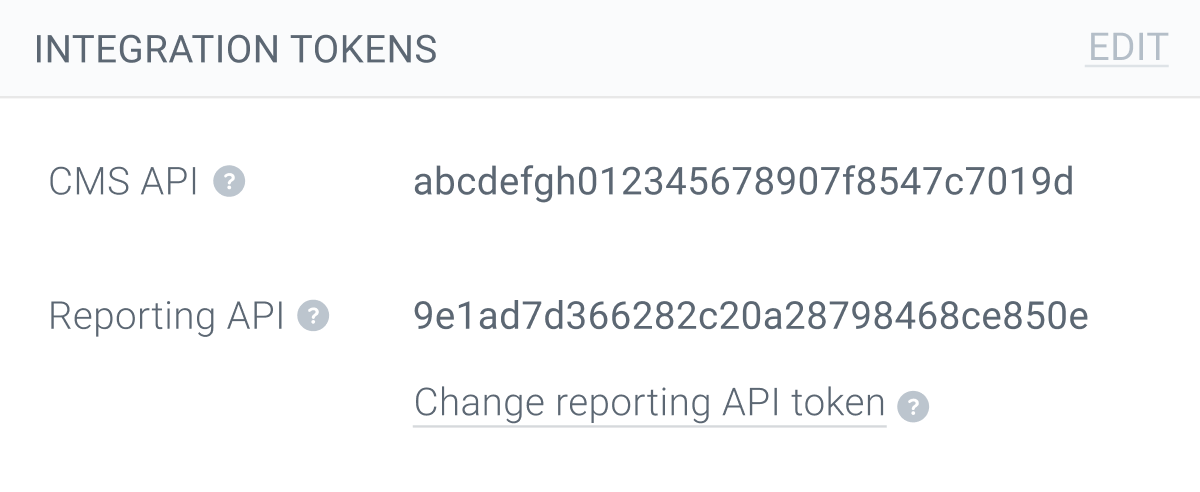
Configure your request headers
To authenticate your requests, you need to include the following request headers:Rate limits
The Reporting API uses rate limits to ensure API request traffic can be handled efficiently. Rate limits define the maximum number of requests which can be made in a given time range. Conductor Monitoring’s Reporting API has the following rate limits:- 6 requests/second/requester IP address
- When the limit is hit the API returns a
429status code for 1 minute
Using the Conductor Monitoring Reporting API
Base URL
Conductor Monitoring Reporting API is available on the following URL:API reference and playground
Every endpoint has its own page with the full parameter list, response schema, example payloads, and an interactive Try it form you can send real requests from.Reporting API Playground
The complete interactive reference for all 14 endpoints.
Start with List websites. Almost every other request takes a
website_id, and that endpoint is where you get it.Entities
Look up the IDs the rest of the API needs.- List websites -
GET /v2/entities/websites - List segments for a website -
GET /v2/entities/segments
Data
Statistics, pages, issues, and log file analysis.- Get statistics -
GET /v2/data/statistics - List pages for a website -
GET /v2/data/pages - Get page data -
GET /v2/data/page - Get log file analysis data -
GET /v2/data/page_lfa - List issues for a website -
GET /v2/data/issues - List affected pages for an issue -
GET /v2/data/affected_pages - Get page issue details -
GET /v2/data/page/issues - Get page broken links -
GET /v2/data/page/issues/broken_links - Get page redirected links -
GET /v2/data/page/redirected_links - Get page canonicalized links -
GET /v2/data/page/issues/canonicalized_links
Alerts
- List alerts for a website -
GET /v2/alerts - List pages for an alert -
GET /v2/alerts/alert_pages
Scoping requests to a website or segment
The statistics and issues endpoints take ascope parameter, which accepts three forms:
Paginating large result sets
Most paginated endpoints require bothpage and per_page. Omitting either returns 400 invalid_payload naming the field you left out:
For sites with 10,000 or more pages, use
page_cursor rather than page. Pass the next_page_cursor value from the previous response to get the next batch; it is faster and more reliable than numbered pages. page_cursor takes precedence over page, so don’t send both.