
The AEO Maturity Matrix: A Framework for AI Search Success
AEO maturity is a measure of an organization's ability to proactively manage, optimize, and scale its visibility across AI answer engines. The ultimate goal is to evolve from reactive, siloed tactics to a fully integrated, automated program. Unlike traditional SEO maturity, it evaluates not just technical foundations and content quality, but how teams are structured, how decisions get made, and how AI search intelligence flows across the entire organization.
Conductor’s AEO Maturity Matrix assesses maturity across four pillars:
- People: Who owns AEO and how accountability scales across the organization
- Process: How AEO work gets done, from reactive fixes to automated agentic loops
- Metrics: What gets measured, from basic ranking data to full AI citation attribution
- Tooling: The technology stack supporting the program at each stage of growth
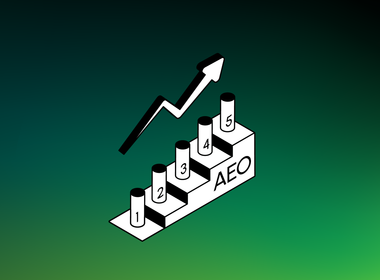
Those pillars are evaluated across five stages of progression:
- Stage 1 — Reactive: No formal strategy; siloed execution by individual contributors
- Stage 2 — Operational: Core SEO/AEO and content teams align around shared tools and processes
- Stage 3 — Strategic: AEO expands cross-functionally with executive engagement
- Stage 4 — Authority-First: Company-wide adoption; brand mandated as the authoritative AI answer
- Stage 5 — Agentic: AI agents handle routine execution; humans focus on governance and strategy
Brands that advance deliberately through each stage build the citation authority, cross-functional alignment, and agentic infrastructure needed to dominate AI search before competitors do.
Most brands have started prioritizing AI search visibility, but experimenting with AEO and having an org-wide strategy that drives reliable results are very different things.
The reality is that success in AEO requires more than a few scattered tactics across teams. To win in an AI-first world, organizations need a structured, scalable approach that aligns cross-functional teams around a shared vision. But how do brands evolve from starting out in AEO to scaling a successful authority-first visibility strategy?
Our AEO maturity framework is a five-level model based on hundreds of real customer conversations over the last 18 months and is designed to help organizations assess their current readiness, identify what holds them back, and know exactly what to work on next. This guide explores the entire AEO maturity model to help marketing, content, SEO/AEO, web, product, and legal teams evaluate their current efforts.
Whether you’re just starting to track AI citations or you’re building agentic workflows, understanding your AEO maturity assessment results will provide the strategic roadmap you need to increase AI-driven search visibility at scale.
What is AEO maturity?
AEO maturity refers to an organization’s ability to proactively manage, optimize, and scale its visibility across AI answer engines and traditional search platforms. It represents the evolution from reactive, siloed tactics to a fully integrated, automated AEO program.
Being mature in AEO doesn’t just mean you publish more content or use more generative AIGenerative AI
Generative AI is a class of AI that creates content like text, images, and code rather than analyzing existing data, powering tools like AI search.
Learn More tools. A mature program dictates how you approach AI search internally. It involves how you structure your teams, who makes the decisions, how you secure executive buy-in, and how you handle complex reporting.
Maturity is a spectrum, not a binary between immature and mature. Most companies today sit in the early maturity stages. They’re more often reacting to AI search changes rather than anticipating and shaping them.
Whether you’re an early-stage startup or an established enterprise, organizations of any size can build a mature AEO program with the right focus and alignment.
Why is AEO maturity important?
As AI search gained mainstream adoption, users now get their queries answered directly via synthesized, conversational answers rather than digging through a list of blue links. That means the brands building structured, repeatable programs to expand their AI presence are pulling away, and there may not be a chance to catch up.
AEO maturity gives teams a shared language. When you can define exactly where your organization stands on the AEO Maturity Matrix, you can align stakeholders, identify opportunities, and better allocate your budget and resources.
The urgency is real. Our research on AI recommendation consistency found that for certain query intents, AI engines rarely change which brands they recommend—the citations are effectively locked in. Early movers in AI search visibility establish citation patterns that compound over time, and for some query types, those patterns are long-lasting. Brands that establish authority now will dominate the AI answer space; those that wait risk becoming invisible in ways that can't be reversed by simply publishing more content later.
How AEO maturity differs from traditional SEO maturity
You might already have a strong SEO maturity model or program in place, but existing SEO maturity frameworks don’t map cleanly onto AEO. While there is some overlap between these models, you need to evolve your framework to account for how AI systems evaluate and surface information.
If you perform well in traditional SEO, you likely sit a bit higher on the AEO maturity scale. You already have a baseline understanding, solid technical foundations, and content optimization best practices. But that foundation typically only gets you to stage two of the AEO maturity model.
Traditional SEO maturity focuses on rankingsRankings
Rankings in SEO refers to a website’s position in the search engine results page.
Learn More, crawlability, and technical health. AEO focuses on citability, authority signals, and answer relevance. But unlike in SEO, there’s no direct equivalent of Google Search ConsoleGoogle Search Console
The Google Search Console is a free web analysis tool offered by Google.
Learn More for AI engine citations.
In addition, AEO requires different things from your content and team enablement. AI engines evaluate comprehensiveness and entityEntity
An entity is a thing/concept that search engines and AI models can identify and relate to other entities, forming the foundation of semantic search.
Learn More clarity, rather than just keywordKeyword
A keyword is what users write into a search engine when they want to find something specific.
Learn More relevance and backlinksBacklinks
Backlinks are links from outside domains that point to pages on your domain; essentially linking back from their domain to yours.
Learn More. AEO also requires content, SEO, and digital teams to align around a single shared visibility goal in ways traditional SEO often doesn’t.
The four pillars of AEO maturity
To accurately gauge your AEO maturity, you need to evaluate your organization across the following four pillars.
- People: Who owns AEO, and how authority is distributed across functions. This tracks the evolution from individual contributors to dedicated leaders, to C-suite mandates, to cross-functional programs, and eventually to agentic governance.
- Process: How AEO work gets done. It measures the shift from reactive fixes and siloed execution to embedded workflows. Advanced processes involve cross-functional collaboration and agentic loops that automatically monitor, surface, and act on insights.
- Metrics: What gets measured and reported. This starts at a baseline of no formal measurement, moves to basic ranking and visibility tracking, and scales to executive-level share-of-voice reporting. The most mature organizations use AI-native funnel analytics to prove ROI.
- Tooling: The technology stack that supports the program. At the lowest level, organizations use disconnected point solutions. It then evolves to using a comprehensive AEO platform, like Conductor, to oversee your AI and traditional visibility. The final stages involve full-stack integration across the CMS, CRM, and BI tools, with the AEO platform acting as the intelligence backbone for agentic systems.
The AEO maturity model
Conductor’s AEO Maturity Matrix maps the journey from reactive, siloed activity to fully agentic, authority-first programs. It spans five distinct stages.

As you review these stages, remember that most companies currently sit at stage one (reactive) or stage two (operational). Advancing takes deliberate cross-functional effort.
Stage 1: Reactive
This is where most companies are today. AEO and traditional SEO are managed in silos by individual contributors or outside agencies with no formal strategy, governance, or measurement for AI search.
- People: Individual contributors or agencies managing SEO and content independently, with no dedicated AEO ownership
- Process: Reactive, ad hoc responses to AI search changes with no documented workflows or editorial standards
- Metrics: No formal AI visibility tracking; executives are starting to ask questions teams can't yet answer
- Tooling: Disconnected point solutions with no unified view of AI or traditional search performance
Your team is aware of AEO but hasn't established clear ownership, can't report on AI citations, and is still figuring out where to start.
The primary goal: Understand how to get visible.
Stage 2: Operational
Organizations at this stage are building operational proficiency. SEO and content teams are establishing basic policies and processes for AI search optimization, but the broader organization remains largely uninvolved.
- People: Core SEO and content teams aligned on AEO basics, with emerging ownership and shared editorial standards
- Process: Documented content optimization workflows in place; basic AI search policies established but not yet cross-functional
- Metrics: AI search visibility is being tracked at the channel level, but not yet tied to broader business KPIs
- Tooling: An AEO platform like Conductor is in use for core teams, providing unified visibility across AI and traditional search
Your team tracks AI citations and follows a documented process, but AEO is still siloed on SEO and content teams, with little executive buy-in.
The primary goal: Centralize and organize your AEO efforts.
Stage 3: Strategic
This stage represents cross-functional AEO at scale. The C-suite increasingly views search authority as a critical aspect of overall business growth, and AEO is embedded into workflows across brand, PR, product, and web development.
- People: AEO spans marketing/brand, PR, product, and web teams; a dedicated leader or function owns the program with executive visibility
- Process: Cross-functional workflows connect content, technical, and brand teams around a shared AEO strategy and editorial calendar
- Metrics: AI visibility tied to revenue metrics; shared dashboards serve multiple departments with consistent reporting
- Tooling: AEO platform integrated directly with CMS, CRM, and BI tools, providing a unified source of truth across functions
AEO has executive buy-in and cross-functional involvement, but your workflows still rely heavily on manual coordination, and you still rely on manual reporting.
The primary goal: Drive business value and collaborate cross-functionally.
Stage 4: Authority-first
This is the journey to total brand authority. Executives mandate that being the authoritative AI answer is a company-wide priority, and every customer-facing team uses AI search intelligence in their daily workflow.
- People: C-suite mandate drives company-wide adoption; every customer-facing team has AEO embedded in their day-to-day responsibilities
- Process: Automated cross-team reporting and real-time alerting replace manual coordination; brand messaging is consistently governed at scale
- Metrics: Real-time executive dashboards track share of voice, sentiment, and citation share across all AI engines
- Tooling: AEO platform serves as the single source of truth for the entire enterprise, feeding live intelligence into every function
Your program is strategic and well-resourced, but you're still running more manual workflows than you should be and haven't yet introduced agentic automation.
The primary goal: Ensure your brand is always the definitive answer in AI search experiences.
Stage 5: Agentic
The final stage features AEO programs that run continuously and self-correct. A small, senior team governs the program with a focus on strategy and brand governance rather than day-to-day execution.
- People: Senior strategists and brand governance leads oversee the program; AI agents handle routine execution tasks
- Process: Agentic loops automatically monitor, surface, and act on AEO insights; human practitioners focus on compliance and strategic pivots
- Metrics: AI-native funnel analytics prove full-funnel ROI; automated reporting surfaces anomalies and opportunities in real time
- Tooling: AEO platform powers AI-native workflows, feeding real-time intelligence directly into agentic pipelines across the enterprise
Your program is mature enough that automation handles the routine work, and your team spends its time on the strategic decisions that no agent can make for them.
The primary goal: Orchestrate and automate your entire search presence.
How to identify your AEO maturity stage
Determining your exact position on the AEO Maturity Matrix requires an honest assessment of your current operations. Since maturity isn’t always uniform or a straight line, your organization might even sit at different stages for different topic areas or business units.
Use these diagnostic signals to find your baseline across the four pillars.
- If you have no dedicated AEO budget, rely on manual workflows, can’t track AI citations, and use disconnected tools, you’re in Stage 1.
- If your AEO/SEO and content teams use shared tools, track basic AI visibility, and follow a documented content optimization process, you’ve reached Stage 2.
- If your PR, product, and web teams actively collaborate with content & AEO/SEO teams, use integrated dashboards, and begin tying AI visibility to revenue metrics, you’re operating in Stage 3.
- If your C-suite mandates AI search authority, all customer-facing teams leverage search intelligence, and you have automated real-time reporting, you sit at Stage 4.
- If AI agents manage your routine AEO monitoring and reporting while your team focuses purely on strategy and governance, you’ve achieved Stage 5.
What it takes to advance between stages
There aren’t any easy buttons or shortcuts here. Advancing from one stage of AEO maturity to the next requires consistent work and a unified strategy. Below is a snapshot of what you can do to improve your AEO maturity and transition to the next stage.
- Stage 1 to Stage 2: You must establish clear ownership of the AEO function. This requires connecting visibility tracking tools and getting your SEO and content teams aligned on a shared editorial plan.
- Stage 2 to Stage 3: You need to earn executive sponsorship. You must expand AEO beyond the core search team and integrate AEO technology with your broader enterprise tech stack.
- Stage 3 to Stage 4: You have to achieve company-wide adoption of AI search intelligence. This means building real-time reporting infrastructure and shifting from basic KPI tracking to a top-down executive mandate.
- Stage 4 to Stage 5: You must ensure your program is mature enough to support automation. You will implement agentic workflows to reduce manual overhead without losing strict brand governance and compliance.
How Conductor customers assess their AEO maturity
The signals above give you a strong starting point, but Conductor customers get a more precise picture. As part of Conductor's customer success program, our team works directly with you to conduct a hands-on AEO maturity assessment, evaluating your current state across all four pillars and mapping exactly where your program sits on the matrix.
From there, your Conductor Customer Success Manager builds a customized journey forward: a stage-specific roadmap that prioritizes the people, process, metric, and tooling gaps most likely to hold your program back. Rather than a generic set of best practices, you get a sequenced plan built around your organization's actual structure, tech stack, and business goals.
The five stages of Conductor’s AEO Maturity Matrix are:
- Reactive
- Operational
- Strategic
- Authority-First
- Agentic
Each stage represents a progression in how an organization handles people, processes, metrics, and tooling related to AI search visibility.
The four pillars are:
- People
- Process
- Metrics
- Tooling
These dimensions are used to evaluate an organization's maturity at every stage of the AEO maturity model.
You can determine your stage by assessing your current capabilities against the four pillars. Look at who owns your strategy, how automated your workflows are, what metrics you track, and whether your technology stack is unified or siloed.
There's no universal timeline for maturing in AEO. It’s also important to note that what actually determines how quickly an organization advances is whether it’s addressed the four pillars. The right people need to be in place, along with a repeatable process, measurement infrastructure, and the technology to support it all.
It will also take longer to move between some stages than others. Moving from Stage 1 to Stage 2 is often an organizational and tooling problem, so brands might be able to grow fairly quickly at first. But the jump from Stage 2 to Stage 3 is harder because it requires executive engagement and cross-functional support beyond the AEO/SEO and content teams.
From there, Stage 4 requires company-wide adoption of AI search intelligence and full-funnel attribution; Stage 5 requires a mature enough program to automate tasks with agentic workflows while humans focus on oversight. Those aren't quarter-long projects; they’ll take significant and consistent effort.
No. While the complexity of execution scales with the size of the business, organizations of any size can and should build a mature AEO program. Small teams can achieve high maturity by establishing efficient processes and leveraging unified tooling.
SEO maturity focuses heavily on technical crawlability, backlink profiles, and traditional keyword rankings. AEO maturity prioritizes brand citability, structured entity data, comprehensiveness, and your ability to appear accurately in AI-generated answers and LLM outputs.
Conductor is the only end-to-end, enterprise AEO platform built on a complete data engine. It provides the unified intelligence layer, scaled AI content generation, and real-time website + technical AEO monitoring needed to transition from reactive workflows to agentic, authority-first programs.
The AEO Maturity Matrix in review
Conductor’s AEO Maturity Matrix is a structured, stage-by-stage framework for measuring your brand's ability to manage and scale visibility across AI search. It helps you turn a vague strategic goal into a defined roadmap for scaling success.
If your teams are siloed and have no shared measurement, the path forward is ownership and basic tooling. If you’re operationalizing AEO but don’t have executive buy-in, the next move is integrating AEO cross-functionally and establishing that buy-in. If your program is strategic but still runs on manual workflows, looking for opportunities to automate with agentic workflows is your next step.
You can’t know where to go next if you don’t know where you are. Before investing in new content, headcount, or tooling, figure out exactly where you stand across all four pillars of your AEO maturity and how to evolve.