
Create Content Built to Perform


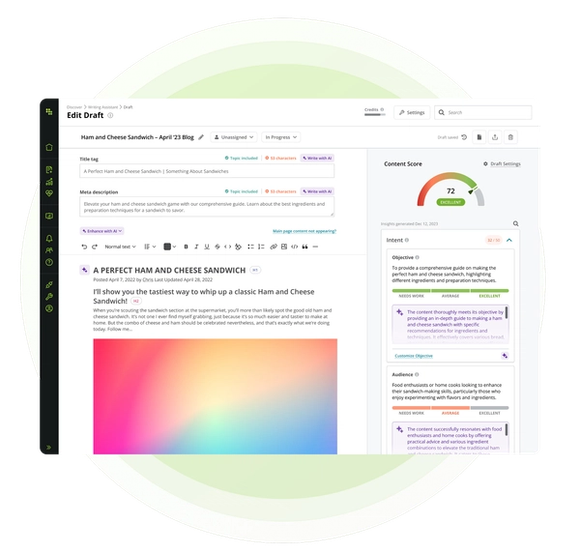


Move From Brief to Publish-Ready in One Workflow
Generic AI can produce quickly, but it does not know your brand, expertise, or our audience’s search demands. Writing Assistant brings those inputs into one creation and optimization workflow, so your team can move faster on content actualy built to win AI search.

See how AI answers your topic before you write a word, including which brands it mentions, which sources it cites, and where yours stands. Writing Assistant turns every signal in search into one brief, so every page starts with a complete view.

Get briefs that lay out the questions to answer, the subtopics to cover, and the key terms to use, all shaped by live AI responses and the fan-out queries AI engines run behind the scenes. Give every piece of content a stronger foundation to compete everywhere your buyers search.

Apply a Content Profile to carry your voice, tone, audience, and exclusions into generation. Add Knowledge Sources to ground the draft in your company's proprietary data, customer evidence, and subject-matter expertise.

Use the Content Score to evaluate Intent Alignment and Topical Coverage as the draft changes. Your team gets a measurable quality signal and specific guidance for improving the content before it publishes.
Hear From Our Customers
Content Guidance & Writing Assistant are most valuable because they free me up, knowing they will have the direction and information needed to write quality content.






Create, Connect, and Manage Content in One Place
Research any topic, even ones you don’t track, to see whether AI engines mention or cite you, which sources they rely on, and which competitors show up instead, then turn it all into one content brief.
Generate outlines and full drafts from a refined brief, then expand, shorten, or revise selected text with AI. Current search insights, Content Profiles, and Knowledge Sources keep the output grounded.
Find semantically relevant pages for a full draft or selected passage, review the proposed anchor text, and insert links without leaving the editor.
Manage drafts through assignees, statuses, ownership details, auto-save, and version history, so your team can coordinate content before publishing.
Frequently Asked Questions
Writing Assistant can generate outlines and full drafts from a refined brief. It can also revise selected text, expand sections, shorten copy, and help create title tags and meta descriptions.
Select a Content Profile to apply saved voice, tone, audience, and exclusions. Add Knowledge Sources to ground generated content in company-provided files or text.
Writing Assistant analyzes patterns such as relevant topics, question structures, and keyword usage across top-ranking pages and AI answers, then synthesizes instructions for generation. It does not use the full raw text of top-ranking pages or AI answers to produce the draft.
The Content Score evaluates Topical Coverage and Intent Alignment. It updates as the draft changes, helping your team see whether the content covers the topic comprehensively and matches the audience’s needs. The score measures how closely the draft matches its brief, built from top-ranking pages and AI answers.
Writing Assistant uses semantic similarity to match a full draft or selected text with relevant pages discovered through Conductor Intelligence. Internal Link Suggestions require both Conductor Creator and Conductor Intelligence, and results depend on available analytics, tracked keywords, or preferred URL data.
Your team can assign drafts, set statuses, review ownership and update details, and restore saved versions. Final publishing remains in your CMS.
AEO signals are the data Writing Assistant collects from AI engines when it researches your topic, including the AI response, fan-out queries, competitor citations and more. Conductor’s Writing Assistant uses these AEO signals, together with top search results, to shape the content brief, so you can create content optimized for everywhere your buyers search.


