
Generating Stronger AI Prompts to Track for AEO / GEO with Conductor
AI search makes visibility harder to track because users aren’t searching keywords anymore; they’re asking nuanced, personalized questions, which means brands need to monitor a lot more prompts than ever before.
But how do you know which prompts are worth tracking? Guessing which prompts are valuable isn’t scalable, and generic LLMs and AEO / GEO visibility tools lack your site’s context, personas, and intent stages, leaving you with generic prompts that don’t offer any valuable insight into your AI visibility.
Learn how Conductor solves this by using your own data to generate and prioritize the prompts that actually influence AI answers.
AI search has transformed the way brands measure and optimize their digital visibility. Success isn’t about keywordKeyword
A keyword is what users write into a search engine when they want to find something specific.
Learn more coverage and SERP rankingsRankings
Rankings in SEO refers to a website’s position in the search engine results page.
Learn more anymore; it’s about appearing in answers generated by AI models like ChatGPT, Perplexity, and Google’s AI Overviews. Since users interact with these engines using full sentences and complex questions, the number of potential prompts is virtually limitless.
But if the possibilities are endless, how are marketers supposed to find the right prompts to track user behavior and AI visibility? Brainstorming a few dozen prompts to track isn’t a sustainable solution for brands of any size. To get an accurate picture of your AI visibility, you need a strategy that mirrors the complexity and scale of real user behavior.
This guide explores how synthetic prompt generation works, why it’s essential for enterprise AI prompt tracking, and how to leverage data to identify the prompts that actually impact your visibility with Conductor.
What is synthetic prompt generation?
Synthetic prompt generation is the process of using AI—an AI visibility tool, or a generic LLM—to create a large volume of relevant, conversational queries that mimic how real users interact with search engines and LLMs.
Unlike traditional SEO keyword research, which focuses on volume and specific phrasing, synthetic prompt generation focuses on intent, context, and nuance. It bridges the gap between a broad topic and the varied, more specific questions that different personas might ask.
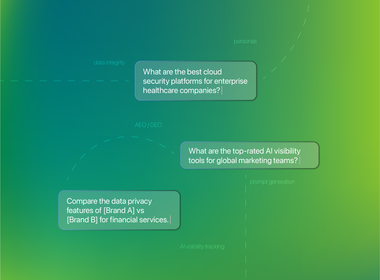
As an example, it’s the difference between a topic like cloud security and a query like “What are the best cloud security platforms for enterprise healthcare companies?”
This approach is critical because AEO / GEO platforms typically organize data into a two-layer structure:
- Topics: The broad themes or content pillars you want to measure.
- Prompts: The hundreds of specific questions per topic that track visibility across different intents and personas.
This structure is essential because it mirrors the semantic architecture of AI models, which prioritize topical authorityTopical Authority
Topical authority is the expertise and credibility a website demonstrates on a subject through comprehensive, interconnected, high-quality content.
Learn more and user intent over simple keywords. While topics align with your website’s core content pillars and expertise, prompts capture the infinite, conversational nuances of how different personas actually ask questions across the buyer’s journey.
Why is synthetic prompt generation critical for AEO / GEO?
Manual prompt selection is not possible for enterprise organizations. The sheer variety of ways users phrase questions means you could miss significant visibility gaps if you rely solely on human intuition or support from generic AI solutions.
Intelligent prompt engineeringPrompt Engineering
Prompt engineering is the craft of designing input prompts for LLMs to elicit desired outputs by framing questions and providing strategic context.
Learn more solves three critical problems in generating prompts to track AI visibility:
- Scale: A single topic can spawn hundreds of relevant questions. Intelligent systems automate the creation of these variations, ensuring you aren't limited by manual entry.
- Persona nuance: A C-level executive asks different questions than a technical practitioner. Intelligent generation accounts for these distinct voices, ensuring your tracking accounts for the nuances of your audience.
- Intent coverage: Users move through distinct stages, from early education to final purchase decisions. Automated AEO prompt generation ensures you have prompts covering every stage of the journey, not just the high-volume "head" terms.
Without this level of sophistication, your tracking data will likely be skewed, missing the long-tail conversational queries where AI engines often provide the most detailed citations.
How does synthetic prompt generation work?
Synthetic prompt generation is a multi-step process that leverages AI, NLP, and vast datasets to simulate how real users ask questions to answer engines or LLMs. At its core, the process begins by defining your primary topics, which are broad themes or pillars aligned with your website’s content strategy and areas of expertise.
Next, AI models analyze how real people talk, search, and ask questions about these topics, pulling in data from search demand, conversation threads, and on-site user behavior to surface common patterns and recurring questions.
Using this analysis, the system automatically creates a wide range of prompts that reflect the full range of ways users phrase their queries. The AI adapts these prompts for different persona types and intent stages. For example, a single topic like cloud security might result in hundreds of variations, like: “What are cloud security best practices for financial services?” or “Which cloud security features are critical for compliance in healthcare?”
Understanding the different methods of prompt generation
Not all synthetic prompt generation solutions are created equal. LLMs and most AEO / GEO tools fail to account for different persona types and intent stages in their data, resulting in generic prompts that don’t offer any actual insight into your AI visibility.
Here are the different ways that you can generate prompts to track your AEO / GEO success.
- Using generic LLMs: This method consists of leveraging an LLM or chatbot like ChatGPT or Gemini to brainstorm ideas for prompts to track around a certain topic. Using our cloud security example from before, you would ask the LLM to provide a list of prompts related to that topic that your audience is searching for, so you can track those prompts.
- Using generic AEO / GEO tools: AEO / GEO visibility tools will work similarly to the LLM workflow, where you’ll pull specific prompts based on a broader topic that you’re looking to target. However, the data will largely be the same as a generic LLM would pull up, because these tools often rely on black box third-party panels or scraped data that represents less than 1% of the real dataset, resulting in generic, statistically insignificant suggestions.
- Using Conductor: Unlike tools that rely on generic indexes or limited third-party "paid panels," Conductor uses your actual website content and architecture as the source of truth for prompt generation. By storing your site in a vector database, our AI can reference specific semantic groupings to generate thousands of highly personalized prompts in minutes. This approach ensures that every prompt is backed by real-world search demand and mapped across the full buyer’s journey, providing the statistical significance and persona-level precision that enterprise brands require to measure success and decide what to prioritize.
This clustering approach ensures you're not left with a repetitive or unhelpful set of prompts but instead one that captures subtle differences in user needs and language. The result is actionable insights, providing you visibility into which prompts your audience is actually using, where your current content stands in the ecosystem, and where opportunity gaps exist for future optimization.
The pitfalls of leveraging LLMs for prompt generation
The short answer is, generic LLM prompt generation isn’t possible for brands to sustain or scale. ChatGPT users send over 2.5 billion prompts per day , and even similar prompts aren’t necessarily worded the same. When you factor in prompts in Perplexity, Google’s AI Overviews, and Claude, that’s an infinite number of prompts, and even more nuances to the way people are searching.
It doesn’t matter if your company is small or enterprise-level; there are simply too many prompts and variations of queries out there for you and your team to cover them all via generic LLM brainstorming.
Couple that with the fact that this style of brainstorming is inherently limited by human bias and internal company nuances. Teams often track the prompts they want customers to ask, instead of the more nuanced and unpredictable ways users actually interact with LLMs. Overall, this approach creates a massive visibility gap, as it fails to account for the diverse range of personas and their specific needs, wants, and ways of speaking.
The pitfalls of leveraging AEO / GEO tools to prompt generation
Many vendors don’t have access to real-time search and AI data or your specific website architecture. Instead, they license third-party data from brokers who scrape information from browser extensions and apps. This black box approach leads to several critical issues:
- Statistically insignificant samples: While marketed as massive datasets, these panels often represent less than 1% of the actual search landscape. With 2.5 billion daily prompts on ChatGPT alone, relying on such a tiny fraction of data makes your tracking results statistically unreliable.
- Poor persona representation: The specific demographic of users who install tracking extensions is narrow and doesn’t represent the diverse range of personas enterprise brands actually target. This makes it impossible to reliably suggest prompts for niche target markets.
- Data integrity and ethics: Competitor data origins are often opaque. Relying on these sources introduces privacy risks and stability issues, as these datasets can be cut off overnight if app store rules or privacy laws change—a risk that is unacceptable for enterprise organizations.
Beyond data quality, the actual functionality of these tools is often restrictive, limiting customization and requiring manual effort to get results. Specifically, most AEO/GEO tools, like Profound, limit your workflows with:
- Lack of site context: Competitor suggestions are limited to what is already in their index and are not directly informed by your specific website content or architecture.
- Manual bottlenecks: The default experience in many AEO/GEO tools requires you to manually add prompts or rely on a limited index sample, which makes it nearly impossible to scale.
- Incomplete intent and persona control: Again, most vendors offer no ability to customize and save specific personas and lack the control to select specific intent stages to target for a group of prompts.
Ultimately, between the limited data scope, large manual lift, and privacy concerns, generating prompts using most AEO / GEO visibility tools isn’t really an improvement over asking ChatGPT to generate prompts for you; their level of context on your brand and goals is the same.
Take a look at how three of the top AEO/GEO solutions on the market approach prompt generation, and learn how Conductor outperforms the competitionCompetition
Businesses generally know who their competitors are on the open market. But are they the same companies you need to fight to get the best placement for your website? Not necessarily!
Learn more by offering a scalable, safe, and highly personalized view of your AI visibility.

Identifying the right prompts to track for AI visibility
Even with automation, you need a strategic framework to ensure you are generating prompts to track AI visibility that align with your business goals. A manual, piecemeal approach will only dilute your data.
Understand your audience and core topics
Start with your website’s existing authority. Your tracking strategy should mirror your content strategy. Focus on topics where you already have content or plan to build it. For each topic, consider the personas involved. Are you targeting technical users who ask "how-to" questions, or decision-makers asking for "best of" comparisons?
Analyze AI search results and conversation patterns
Before finalizing your list, take the time to analyze the AI platforms themselves. Look at how engines like ChatGPT or Perplexity handle your core topics. Do they surface lists? Do they offer detailed guides? Understanding the output helps you reverse-engineer the input.
Curate a prompt list using data insights
While broad coverage is beneficial, relevance is a more accurate indicator of your visibility. A strong strategy relies heavily on unbranded prompts—typically accounting for around 75% of your total mix. This reveals where you’re winning new audiences rather than just confirming you own your brand name.
Learn how to set up AI prompt tracking to get accurate visibility into how AI models talk about your brand and what you can do to optimize.
How Conductor generates prompts to track AI visibility
Most AEO / GEO solutions on the market struggle to provide accurate AI prompt generation because they rely on flawed data sources. These tools license third-party data from brokers who scrape information from browser extensions. This results in paid panels that represent less than 1% of the real dataset and often ignore key personas enterprise brands need to track.
Conductor takes a fundamentally different approach. We combine your proprietary website data with proven search demand to generate thousands of targeted prompts in minutes.
Conductor is uniquely positioned to help you generate prompts to track AI visibility because our data is rooted in your brand's own digital ecosystem. By focusing on data integrity and specialized AI modeling, Conductor ensures that the prompts you track are statistically significant and strategically aligned with your business.
Data integrity: The Conductor advantage
Unlike competitors who rely on generic indexes, Conductor uses your actual website content as the source of truth for prompt generation. This leads to several key benefits, including:
- Topical focus: The system analyzes your site's architecture and content to understand your specific topical authority.
- Vector database personalization: For enterprise-level precision, Conductor can store your site in a vector database, allowing the AI to reference specific pages and semantic groupings for hyper-personalized prompt suggestions.
- Real demand integration: Topics are not just guessed; they are prioritized based on actual organic search demand specific to your target geographies.
Advanced persona customization
Conductor recognizes that AI search results are inherently personalized, while other vendors often fail to account for personas entirely, leading to skewed data that doesn't represent the diverse B2B or B2C audiences of enterprise brands.
Conductor’s approach helps you get a full, clear picture of your AI visibility, offering you:
- Persona inclusion by default: Relevant personas are baked into the prompt generation process from the start.
- Granular control: You can upload custom personas and map them directly to specific product offerings or services to ensure the prompts reflect how your actual customers interact with AI.
Mapping the buyer’s journey
Conductor moves beyond high-volume keywords by automatically mapping prompts to the natural distribution of the full customer lifecycle for your topic, or allowing you to manually select which stages to target.
- Education: Foundational knowledge and "what is" queries.
- Recommendations: Discovery of solutions or top-rated products.
- Comparison: Direct side-by-side evaluations of products or services.
- Pricing: Research into costs, value, and budget alignment.
- Brand/Service nav: Direct queries regarding specific company offerings.
- Purchase: High-intent prompts signaling a readiness to buy.
- Support: Post-purchase help and troubleshooting queries.
Unlike competitors who only offer partial filtering, Conductor allows you to select exactly which intent stages you want to focus on before you generate your prompt list.
Rejecting paid panels for data integrity
Another key differentiator for Conductor is that we don’t use broker data from browser extensions or apps. Leveraging broker data isn’t a solid foundation for generating prompts to track, because it makes your insights less reliable and less indicative of your actual performance. Specifically, this data provides:
- Statistical insignificance: With 2.5 billion daily prompts on ChatGPT alone, the sample sizes used by many competitors represent less than 1% of the total dataset, making them statistically insignificant.
- Ethical instability: Relying on third-party data introduces privacy risks and the danger of datasets being cut off overnight due to changing app rules. Conductor’s model provides a stable, enterprise-grade alternative.
- Insufficient demographic representation: The users who install tracking extensions do not represent the diverse personas enterprise brands are trying to connect with. The data is heavily skewed, making it impossible to reliably suggest prompts for specific B2B or B2C personas.
Synthetic prompt generation in review
The transition from traditional SEO to AEO / GEO requires a fundamental shift in how brands handle data and scale. Relying on limited third-party black box panels or manual brainstorming isn’t possible for enterprise brands, draining resources and opening up unnecessary risk.
To achieve true visibility in an AI-driven world, you need a strategy rooted in data integrity that leverages your own website's authority, accounts for the complexity of user personas, and maps to the entire buyer’s journey.
By moving toward automated, site-informed synthetic prompt generation, you’re building a scalable roadmap to ensure your brand is the definitive answer, no matter how or where your customers are searching.