
The 8 Best Enterprise SEO Platforms in 2026: Ranked
Enterprise SEO shapes how content is surfaced across traditional search and AI-powered discovery, but visibility still comes down to platforms that can scale, prioritize the right work, and support consistent execution.
The platforms ranked here, including Conductor, Semrush, and Botify, stand out for helping enterprise teams build that foundation and earn visibility across both traditional search engines and AI search experiences.
Search no longer lives on a single results page.
Discovery now happens across traditional search engines, AI-powered answers, and generative experiences that decide which brands get cited—and which get skipped. Users are increasingly getting answers without clicking, while AI systems synthesize content from sources they deem authoritative enough to trust.
At the same time, Google still processes approximately 16.4 billion searches every day, reinforcing a critical truth: SEO hasn’t been replaced. It has become the foundation behind nearly every modern discovery experience.
What hasn’t changed is how visibility is earned. Relevance, authority, technical health, and high-quality content still determine what surfaces for both people and AI systems. If your SEO fundamentals are weak, no amount of AI optimization will save you.
For enterprise organizations, this reality is harder to manage. Large sites, complex architectures, and distributed teams make it difficult to see what’s actually driving performance. Dashboards full of raw data don’t solve the problem. Progress requires clarity, prioritization, and a clear link between SEO work and business impact.
That’s where enterprise SEO platforms matter. The strongest platforms don’t just report on rankingsRankings
Rankings in SEO refers to a website’s position in the search engine results page.
Learn more. They guide decisions, align teams, and help organizations scale visibility across both traditional search and AI-driven discovery. This guide shows which platforms are built to do that in 2026.
How we ranked the best enterprise SEO platforms
Enterprise SEO isn’t just SEO at a larger scale; it’s a different discipline entirely. It means managing hundreds of thousands or even millions of pages, navigating complex site architectures, and coordinating optimization efforts across teams and regions while still driving measurable business impact.
That reality raises the bar for enterprise SEO platforms. The strongest solutions move beyond data to drive prioritization, cross-team execution, and clear connections to business impact, while supporting visibility across both traditional and AI-powered search experiences.
Those are the principles that guided our rankings. Platforms were evaluated across the following areas:
- Scalability and data reliability for large, complex websites
- Insight quality and prioritization, not just raw data access
- Content optimization and performance measurement at scale
- Support for AI search and AEO
- Workflow enablement across SEO, content, and digital teams
- Executive reporting and business impact visibility
Overall rankings reflect how well each platform supports enterprise organizations navigating both today’s search landscape and the future of AI discoverability.
The best enterprise SEO platforms: Ranked
#1: Conductor
Conductor ranks first because it helps enterprise teams win visibility across all modern search experiences, not just traditional SERPs. As AI-powered search and generative experiences increasingly determine which content gets surfaced and cited, enterprise SEO requires platforms that help teams strengthen the signals both AI systems and traditional search algorithms rely on, including relevance, authority, structure, and content quality.
Rather than overwhelming teams with raw data, Conductor focuses on clarity and action. Its intelligence layer connects SEO and content efforts directly to outcomes that matter for both SEO and AEO, and is continuously evolving alongside changes in search, helping organizations stay aligned with how visibility is earned across traditional results and AI-driven discovery.
Built specifically for large, collaborative teams, Conductor supports the full SEO/AEO and content lifecycle—from opportunity identification to technical optimization to performance measurement—making it easier to unify strategies, collaborate across teams or regions, accelerate results, and prove impact at the executive level.
Core enterprise SEO features
- Enterprise-scale keyword, topic, and audience intelligence
- Content optimization aligned to search intent, authority signals, and content quality
- Large-scale site auditing, crawling, and technical SEO monitoring
- Performance measurement tied to traffic, engagement, and conversions
- Competitive and market visibility analysis across search landscapes
- AI-powered insights that support SEO and AEO readiness
- API access and flexible executive-level reporting for custom analysis and decision-making

Key differentiators
Conductor stands out for its data integrity, security, and trustworthiness at scale. Enterprise organizations depend on accurate, consistent insights to guide high-impact decisions, with confidence that their data is protected. Conductor is built with enterprise-grade security and governance in mind, ensuring customer data is safe, reliable, and ready to use across large, complex websites.
Beyond data quality, Conductor supports how enterprise teams actually work. It gives large, collaborative teams a single source of truth for executing SEO, AEO, and content marketingContent Marketing
Content marketing is a marketing discipline with the goal of increasing awareness and scope for products and brands in the desired target group with content published on the web and offline.
Learn more consistently at scale.
Conductor’s Model Context Protocol (MCP) extends this foundation by enabling secure, structured access to trusted SEO and AEO intelligence wherever teams work. Through data and API connections, organizations can integrate Conductor insights into their broader martech stack or query performance directly within AI tools, helping teams move faster and make better decisions without compromising data trust.
Combined with workflow-driven intelligence and cross-team collaboration, Conductor helps organizations operationalize SEO as a strategic growth driver and a foundation for long-term visibility across search and AI-powered experiences.
Limitations
Conductor is purpose-built for enterprise organizations, which means it may exceed the needs of SMB-focused use cases or smaller teams looking for lightweight or purely tactical SEO tools.
Best for
Large organizations managing complex websites and content ecosystems that need trusted data, scalable insights, and a platform built to support both SEO performance and AI-driven discovery.
#2: Semrush Enterprise
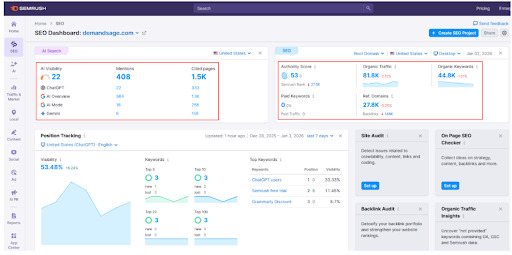
Semrush Enterprise ranks highly for its breadth of SEO data and competitive insights. It’s strong for organizations that need visibility into keywords, competitors, backlinksBacklinks
Backlinks are links from outside domains that point to pages on your domain; essentially linking back from their domain to yours.
Learn more, and SERP dynamics across many markets.
For enterprise teams focused on research, competitive analysis, and opportunity discovery, this platform provides a powerful dataset. Its tools help teams understand where they compete, where they’re losing ground, and how search landscapes are shifting. That said, while Semrush’s data has some overlap with AEO-related analysis, it is not purpose-built for AEO.
Core enterprise SEO features
- Large-scale keyword research and tracking
- Competitive and market analysis across regions
- Backlink analysis and authority monitoring
- Site auditing and technical SEO diagnostics
- Content and SERP analysis tools
- API access and custom reporting options
Key differentiators
Semrush’s primary differentiator is data breadth. The platform surfaces competitive intelligence across keywords, backlinks, and SERP features at scale. This makes it especially valuable for teams that want to explore markets, analyze competitors, or support SEO research across multiple business units.
Semrush also offers a broad ecosystem of tools beyond SEO, including paid media and social insights. For some enterprise organizations, that versatility can make it easier to centralize research and analysis across channels, even if execution happens elsewhere.
Limitations
Semrush leans heavily toward data access rather than execution. While its datasets are extensive, enterprise teams are often left to interpret, prioritize, and operationalize insights on their own. Workflow enablement, cross-team collaboration, and executive-level reporting typically require additional tooling or significant customization to scale effectively.
Best for
Enterprise organizations that prioritize SEO research and competitive intelligence. Best for teams already invested in the Semrush ecosystem.
#3: Botify
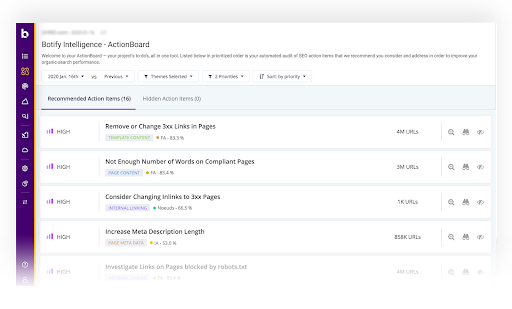
Botify ranks highly for its strength in technical SEO and crawl-based analysis at an enterprise scale. It’s designed for organizations managing large, complex websites where understanding crawl behavior, indexability, and site architecture is critical to search performance.
For enterprise teams responsible for massive sites with complex architecture, Botify provides visibility into how search engines interact with their sites. Its crawl, log file, and rendering analysis help identify technical issues that can limit visibility, particularly for sites with millions of URLs or frequent structural changes. This technical foundation also supports modern search, where clean architecture and accessibility remain essential.
Core enterprise SEO features
- Large-scale crawling and log file analysis
- JavaScript rendering and indexability insights
- Technical issue detection across massive sites
- Site architecture and internal linking analysis
- Monitoring of crawl budget and search engine behavior
- Integration with analytics and search data sources
Key differentiators
Botify is distinguished by its technical depth. Similar to Conductor, the platform provides detailed visibility into how search engines crawl, render, and index enterprise websites, which is critical for organizations managing highly complex or dynamic site architectures.
Its strength lies in technical validation and control. Botify enables teams to analyze JavaScript rendering, monitor crawl behavior, and assess the real impact of technical changes over time. This depth of technical visibility supports organizations managing large, complex websites.
Limitations
Botify is highly specialized in technical SEO, but teams looking for support with content strategy, collaborative workflows, or business-level prioritization will find its capabilities limited outside of technical analysis. As a result, Botify is most effective when paired with other platforms that handle content optimization and cross-team execution.
Best for
Large organizations with complex, dynamic websites that require deep technical SEO analysis and precise control over crawl and indexation at scale.
#4: seoClarity
seoClarity earns its place for its focus on automation and data-driven SEO execution at scale. It’s built for enterprise teams that want to manage large keywordKeyword
A keyword is what users write into a search engine when they want to find something specific.
Learn more sets, track performance across markets, and forecast the impact of SEO initiatives over time.
For organizations with complex reporting needs, seoClarity offers robust capabilities around rank tracking, keyword intelligence, and performance forecasting. Its platform is well-suited to teams that need to monitor SEO performance across multiple sites or regions and model how changes may affect visibility and traffic.
Core enterprise SEO features
- Large-scale rank tracking and keyword intelligence
- SEO forecasting and opportunity modeling
- Technical SEO monitoring and alerts
- Content optimization recommendations
- Competitive analysis across markets
- Custom dashboards and reporting

Key differentiators
seoClarity helps enterprise teams move beyond reactive reporting by modeling potential outcomes and identifying opportunities at scale. This can be especially valuable for organizations that need to plan SEO investments, set expectations with stakeholders, or manage performance across large portfolios of pages.
The platform also offers flexible reporting and data customization, allowing teams to tailor dashboards to specific audiences, from users to executives.
Limitations
This platform’s depth and flexibility can come at the cost of usability. The platform often requires experienced SEOs to fully leverage its capabilities, and translating forecasts or recommendations into coordinated action may require additional internal processes. Teams without mature SEO operations may find adoption and execution challenging.
Best for
Enterprise organizations that prioritize automation, forecasting, and large-scale SEO performance tracking. Best suited for teams with established SEO expertise and processes.
#5: Siteimprove
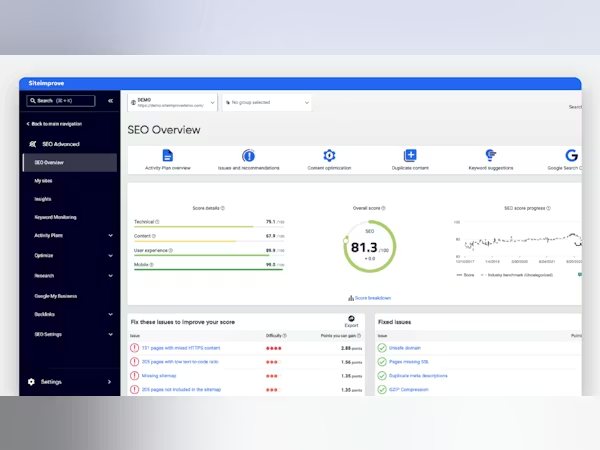
Siteimprove earns its spot for its strength in content quality, governance, and compliance at enterprise scale. While not a traditional SEO-first platform, it plays an important role for organizations that need to maintain high standards across large volumes of content.
For enterprise teams managing complex content ecosystems, Siteimprove helps identify issues related to content quality, accessibility, and technical health. Its insights support SEO fundamentals by improving site health, user experienceUser Experience
User experience (or UX for short) is a term used to describe the experience a user has with a product.
Learn more, and content consistency—factors that remain critical for both search engines and AI-driven discovery.
Core enterprise SEO features
- Content quality and SEO issue detection
- Accessibility and compliance monitoring
- Technical site health insights
- Content governance and policy enforcement
- Cross-site reporting and audits
- Integrations with CMS and analytics platforms
Key differentiators
Siteimprove stands out for its focus on governance and quality assurance. The platform helps large organizations enforce content standards, reduce risk, and maintain consistency across distributed teams and sites. This makes it particularly valuable for highly regulated industries or organizations operating in regions with strict accessibility and compliance requirements.
By surfacing issues that affect usability and trust, Siteimprove supports the SEO foundations that both traditional search engines and AI systems depend on, even if it doesn’t focus on keyword strategy or competitive analysis.
Limitations
Siteimprove is not designed to replace a full enterprise SEO platform. While it excels at quality, accessibility, and compliance, it offers limited support for keyword intelligence, prioritization, or search-driven growth initiatives. Most enterprise teams will need a dedicated SEO platform alongside Siteimprove to support performance-focused goals.
Best for
Enterprise organizations that prioritize content quality, accessibility, and compliance and need scalable governance across large, complex domains.
#6: Ahrefs
Ahrefs ranks as a strong option for enterprise teams focused on backlink analysis, competitive research, and authority-building strategies. It’s widely known for its extensive link index and visibility into how websites earn and lose authority over time.
For organizations investing heavily in digital PR and off-site SEO, Ahrefs provides insight into backlink profiles, referring domains, and competitive link gaps. These authority signals play a key role in determining which brands are surfaced and cited across both traditional search results and AI-powered answers.
Core enterprise SEO features
- Backlink analysis and link monitoring
- Competitive domain and content research
- Keyword research and rank tracking
- Content gap and topic analysis
- Site auditing and technical SEO insights
- API access for custom analysis

Key differentiators
Ahrefs is best known for its link intelligence. The platform offers detailed visibility into backlink profiles and competitive authority signals, making it a strong resource for teams focused on earning, monitoring, and defending link equity at scale.
Its content and keyword research tools also support opportunity discovery, particularly for identifying topics and gaps based on competitor performance.
Limitations
Ahrefs is built for analysis, not enterprise SEO execution. While its research capabilities are strong, it lacks native workflow support, content collaboration features, and executive-ready reporting. Enterprise teams will need additional platforms or custom processes to translate Ahrefs insights into coordinated action at scale.
Best for
Enterprise organizations that prioritize backlink analysis, authority building, and competitive research, with established workflows to turn insight into action.
#7: BrightEdge
BrightEdge remains a recognized name in enterprise SEO, particularly among large organizations that have invested in the category for many years. The platform offers broad SEO capabilities designed to support large websites, global teams, and long-term search efforts.
For enterprise teams that prioritize scale and standardized reporting, BrightEdge provides a simplified view of SEO performance across markets and properties. Its data and insights help organizations monitor rankings, track content performance, and maintain visibility across competitive landscapes.
Core enterprise SEO features
- Enterprise rank tracking and keyword monitoring
- Content performance and optimization insights
- Competitive analysis and market visibility
- Technical SEO monitoring and diagnostics
- Global reporting and dashboards
- Integrations with analytics and CMS platforms

Key differentiators
The platform has long been adopted by large organizations seeking a single, simple system to track SEO performance across multiple regions and business units.
Its reporting and governance capabilities support standardized SEO measurement, which can be valuable for organizations with established processes and long planning cycles.
Limitations
Enterprise teams often find BrightEdge less intuitive and more rigid compared to more advanced platforms on this list. Insight prioritization, workflow enablement, and content collaboration require additional effort, and teams will need complementary tools to support execution and cross-functional alignment.
Best for
Large enterprises with established SEO programs focused on standardized reporting and global visibility. Best aligned with organizations that value platform stability over flexibility or innovation.
#8: Sistrix
Sistrix earns its place for its focus on search visibility measurement and market-level analysis. The platform is well known for its Visibility Index, which provides a high-level view of how domains perform in search relative to competitors over time.
For enterprise teams that want a clear, directional understanding of SEO performance across markets, Sistrix offers a straightforward way to monitor gains and losses in visibility. Its strengths are particularly evident in European markets, where the platform has deep data coverage and long-standing adoption.
Core enterprise SEO features
- Search visibility and performance tracking
- Competitive market and domain analysis
- Keyword discovery and ranking insights
- On-page SEO analysis
- Content and SERP feature monitoring
- Historical performance comparisons

Key differentiators
Sistrix is notable for its visibility-centric approach. Rather than focusing on granular workflows or execution, the platform emphasizes macro-level performance signals that help teams understand overall search momentum and competitive positioning.
Its simplicity and clarity make it useful for high-level reporting and market monitoring, particularly for organizations operating across multiple regions.
Limitations
Sistrix is primarily a measurement and analysis tool. It offers limited support for prioritization, content optimization, or cross-team execution, and it is not designed to manage SEO workflows at enterprise scale. Teams focused on driving action and operational impact will likely need additional platforms to support execution.
Best for
Organizations that want a clear, high-level view of search visibility and competitive performance, especially those with a strong presence in European markets.
Winning visibility in AI search means using tools built for LLM-driven discovery. The 10 Best AEO / GEO Tools: Ranked and Reviewed compares the platforms designed to help content show up across generative search experiences.
How to choose the right enterprise SEO platform
The right enterprise SEO platform shapes more than rankings. It influences whether your content is understood, trusted, and surfaced across modern search experiences, including AI-powered answers.
That’s because modern AI systems don’t replace SEO fundamentals—they depend on them. Authority, relevance, technical health, and content quality still decide which brands get cited or ignored. Even if your organization hasn’t formally adopted AEO practices, your SEO platform is already affecting how visible your content is in AI-driven discovery.
That’s why enterprise teams need platforms that go beyond collecting data. The strongest solutions help teams reinforce the signals that search engines use to evaluate content, while making it easier to connect SEO work to real business outcomes.
When evaluating enterprise SEO platforms, consider:
- Does it help teams identify and prioritize the opportunities that will have the greatest impact?
- Does it unify SEO, content, and technical intelligence in one place, rather than siloed tools or reports?
- How well does it support content optimization and performance measurement at scale?
- Does it strengthen visibility across both traditional search and AI-driven discovery?
- Can it support collaboration across teams and provide clear, executive-level reporting tied to business outcomes?
Choosing the right enterprise SEO platform isn’t about chasing the next search trend. It’s about building an SEO foundation that earns visibility wherever discovery happens next.
FAQs
What makes an SEO platform enterprise-grade?
An enterprise SEO platform is built to handle scale and complexity. That includes reliable data for large websites, support for multiple teams and regions, advanced reporting, and the ability to prioritize high-impact work. Enterprise platforms focus on insight, coordination, and business impact, not just individual SEO tasks.
How are enterprise SEO platforms different from SMB SEO tools?
SMB tools are typically designed for single sites, small teams, and tactical execution. Enterprise SEO platforms support complex site architectures, distributed workflows, and executive reporting. They also emphasize data integrity, scalability, and visibility across multiple markets and business units.
Is SEO still important with AI-powered search and AEO?
Yes. SEO remains the foundation of AI-powered search. AI systems rely on traditional SEO signals like relevance, authority, structure, and content quality to determine what content gets surfaced or cited. AEO builds on SEO rather than replacing it.
How do enterprise SEO platforms support AI visibility and AEO?
Enterprise SEO platforms support AI visibility and AEO by helping teams identify, prioritize, and execute the work that influences how content is evaluated. By improving content quality, technical strength, internal linking, and authority, teams increase the likelihood that content is surfaced in AI-generated answers and discovery experiences. Even teams not actively optimizing for AEO benefit from stronger SEO fundamentals.
What teams typically use enterprise SEO platforms?
Enterprise SEO platforms are used by SEO teams, content and editorial teams, digital marketing leaders, and executives at enterprise organizations. The best platforms support collaboration across these groups at scale, making it easier to align priorities, execute consistently, and measure impact at both tactical and strategic levels.
Enterprise SEO in an AI-driven search landscape
Enterprise SEO isn’t being replaced by AI-powered search; it’s being reinforced by it. As discovery expands beyond traditional results, the signals that determine visibility remain grounded in SEO fundamentals like relevance, authority, structure, and content quality.
What separates enterprise platforms is how effectively they help teams strengthen those foundations at scale. The strongest solutions prioritize clarity over volume, support collaboration across teams, and help organizations focus effort where it delivers the most impact.
In an environment where trust drives visibility, execution matters more than ever. Enterprise SEO platforms that enable consistent, prioritized action are the ones shaping how brands appear across modern search.