
How to Optimize Content for Google’s AI Overviews: A 10-Step Guide
How to optimize for AI Overviews:
- Provide direct, concise answers to complex questions. Lead with the answer in the first paragraph or immediately under the header. Then expand with context, examples, and supporting detail.
- Use clear H2 and H3 headers that mirror real user prompts. If someone were to type the question into Google, it should look like a header on your page.
- Implement structured data (schema) to clarify entity relationships. Help Google understand what your content is, how topics connect, and which sections are answer-ready.
- Cite authoritative, expert-led, and original data to satisfy E-E-A-T. Incorporate first-hand insights, proprietary research, and credible sources that demonstrate real experience and expertise.
Improve your content's visibility in AI-powered search results in Google with these 10 proven strategies, from E-E-A-T principles to schema markupSchema Markup
Schema markup is structured data added to web pages that tells search engines what content means, enabling rich results and enhanced search features.
Learn more and beyond.
With the increasing popularity of AI-powered search models like Claude , ChatGPT , Perplexity , and the prevalence of Google’s AI Overviews in traditional SERPs, the tried and true SEO best practices aren’t yielding the results they used to. Brands need to adapt in order to ensure their content is visible on AI search as well as traditional search.
The good news is that the rules of the game with AI search aren’t too different from SEO. AI-driven search engines prioritize well-structured, authoritative, and relevant content. Whether you're looking to improve visibility in AI Overviews or ensure your expertise is effectively recognized by LLMs, follow these best practices to improve visibility in AI answer engines and ensure your content is effectively recognized by large language models (LLMs).
Understanding what triggers an AI Overview
Before you start optimizing for Google’s AI Overviews (AIO), you first need to understand what triggers them. AI Overviews don’t appear for every query, but they’re appearing far more often than many teams realize.
According to Conductor’s 2026 AEO/GEO Benchmarks Report, 25% of Google searches now generate an AI Overview, based on an analysis of 21.9 million queries. In some industries, the impact is even greater. Healthcare searches, for example, see AI Overviews appear in nearly 50% of results, dramatically changing how users discover information.
This means that for many topics, AI-generated summaries are no longer an edge case; they’re a core part of the search experience.
AI Overviews tend to appear most often for informational and how-to queries, especially when users are looking for explanation, synthesis, or step-by-step guidance rather than a single fact.
For example, queries like:
- How to optimize content for AI Overviews
- What is answer engine optimization?
- How does schema markup impact AI search?
…signal that the user wants clarity and depth. That’s where AI-generated summaries are most likely to appear in search results.
But query type is only part of the equation.
Google’s AI systems also look for information gaps, areas where the top 10 blue links don’t fully answer the question, lack nuance, or repeat the same surface-level advice.
If every ranking page says:
- Use keywords
- Add headers
- Write high-quality content
…that’s consensus. It’s not differentiation.
Content that earns AI citations typically goes further. It:
- Introduces new entities or concepts competitors don’t mention
- Adds original data, examples, or first-hand experience
- Connects related topics in a clearer, more structured way
- Answers follow-up questions before the user has to ask
In other words, AI Overviews favor content that demonstrates depth, synthesis, and expertise, not just a generic “how-to” checklist.
If you want to increase your likelihood of being referenced or cited in an AI Overview, don’t just match what’s already ranking—fill the gaps.
Here are 10 strategies to help your content stand out, add value to the conversation, and increase its chances of being cited in AI Overviews.
1. Craft content for AI summarization & readability
AI Overviews prioritize clear, authoritative, and well-structured content that directly answers user queries.
To improve your chances of being cited, write clear, authoritative content:
- Align every section to a specific user query
- Avoid filler or vague statements
- Lead with the answer, then expand with context
Both AI systems and users favor structured content. To make content skimmable, use:
- FAQ sections for direct answers
- Bullet points and numbered lists for key takeaways
- Clear H2 & H3 subheadings for logical flow
- Bold or highlight text to emphasize important points
If your content can't be easily scanned, it's unlikely to be easily summarized.
2. Optimize on-page elements for AI recognition & search visibility
AI systems still rely on traditional SEO signals to understand content relevanceContent Relevance
Content Relevance is used to indicate how relevant a website is in relation to a particular search term or topic.
Learn more. You can strengthen your on-page optimization by:
Use targeted keywords strategically:
- Include primary keywords in your title tag and H1
- Reinforce them naturally in headers and body copy
- Align language with real search queries
Enhance formatting for readability by:
- Keeping paragraphs short
- Breaking up dense sections
- Using descriptive headers instead of vague ones
The goal isn't keywordKeyword
A keyword is what users write into a search engine when they want to find something specific.
Learn more stuffing, it's semantic clarity.
3. Optimize for conversational AI and question-based queries
AI-driven search increasingly favors natural, question-based queries and conversational content. Structuring content to align with these trends improves visibility in AI-generated search results and voice searches.
- Write in a conversational tone: Mimic natural speech patterns and structure content in a way that aligns with how users phrase queries in voice and text searches.
- Use Q&A formats: Clearly present questions and answers to match AI-generated search summaries and voice search responses.
- Target long-tail keywords: Capture more specific user intent by incorporating detailed, question-based queries that drive engagement and conversion.
- Incorporate keyword variations: Use alternative phrasings and related terms to maximize discoverability across different AI interpretations.
For example, instead of only targeting “AI Overview optimization,” you can also include question-based phrasing like “How do I optimize for Google AI Overviews?” or “How can I rank in AI-generated summaries?” as H2 or H3 headers, followed by concise answers within the content.
AI systems look for content that directly mirrors real-world phrasing.
4. Keep content fresh and updated
AI systems prioritize up-to-date, accurate information. To maintain AI visibility:
- Refresh outdated statistics and examples
- Add new industry insights
- Remove or revise deprecated best practices
- Update publish dates when significant improvements are made
Outdated content is less likely to be trusted and cited.
Refreshing content regularly is easier with the right visibility. Conductor helps teams identify outdated pages, track performance trends, and uncover opportunities to update content so it stays competitive in both search and AI-generated results.
5. Identify relevant keywords and sources
AI Overviews frequently cite authoritative sources. Understanding which sources appear repeatedly can help inform your strategy.
To strengthen your position:
- Analyze which domains are cited in AI Overviews for your target topic.
- Identify recurring entities and themes.
- Expand coverage around related subtopics that competitors miss.
- Build topical authority across clusters, not just single pages.
The goal isn’t just to rank, but to become a trusted source within the topic ecosystem.
6. E-E-A-T is the foundation; information gain is the winner
E-E-A-T (Experience, Expertise, Authoritativeness, and Trustworthiness) is table stakes for ranking in traditional search, and in AI search, it’s even more critical. But here’s the nuance most guides miss: E-E-A-T gets you in the conversation—information gain gets you cited.
AI Overviews don’t just summarize the highest-ranking pages. They synthesize information across sources and prioritize content that adds something new to the discussion, especially when it fills an information gap.
If your page simply repeats what’s already in the top 10 blue links, you’re contributing to consensus. If your page introduces new, relevant insight, you’re contributing to synthesis.
That’s the difference between being indexed and being referenced.
E-E-A-T matters, and authorship is back: Dive into E-E-A-T's impact and how to maximize your content quality and authority.
Because this concept is so central to earning AI citations, it’s worth taking a closer look at how it works in practice.
The information inventory framework
Information gain isn’t about writing more; it's about contributing something unique.
To do that consistently, you need to build what we call an information inventory, a structured list of insights your organization can uniquely provide.
You can build that inventory by drawing from three primary sources:
- Proprietary data: Share results from internal analyses, surveys, anonymized customer trends, or platform-level research. Original data introduces new entities into the topic and strengthens your authority.
- First-hand experience: Reference lessons learned from real-world implementation. Phrases like “In our testing…” or “When we implemented this…” signal applied expertise, not recycled commentary.
- Counter-narratives: Don’t be afraid to refine or challenge oversimplified industry advice. When you provide a more nuanced perspective (supported by data or experience), you contribute meaningful differentiation.
Information gain comes from adding insights that move the conversation forward. If your page simply echoes what’s already ranking, it blends in and gets ignored. If it adds relevant depth or missing context, it becomes citation-worthy.
The claim-evidence formatting
AI Overviews look for specific "nuggets" of new info, concise, defensible insights they can extract and synthesize to bridge knowledge gaps. If your strongest ideas are buried in long paragraphs, they’re harder for both users and AI systems to identify.
One of the most effective ways to surface information gain is through a clear claim–evidence structure.
Here’s how it works:
- Use an H3 that frames a specific, insight-driven question
- Follow that with a direct answer in one to two sentences
- Support that answer with data, examples, or documented observations
This makes your content easier to summarize and to trust.
For example:
- H3: Does information gain impact AI Overview citations?
- Direct answer: Yes. Pages that introduce original data and novel entities are more likely to be cited because they fill information gaps not covered in consensus results.
- Evidence: Link to a case study or insert a screenshot of a data table.
Structuring insights this way makes it clear where the value in your content comes from and provides evidence that reinforces your credibility.
The entity gap strategy
Google's AI systems don't evaluate your page in isolation. They compare it to the existing consensus results, typically the top-ranking pages for a query. Those results establish the baseline coverage of a topic. If most of the ranking pages mention the same entities, such as "keywords" or "metadata," they reinforce the same core ideas.
Opportunities appear when relevant entities are missing from that consensus.
If your research shows that competitors haven't written about concepts like Retrieval-Augmented Generation (RAG), semantic density, or entityEntity
An entity is a thing/concept that search engines and AI models can identify and relate to other entities, forming the foundation of semantic search.
Learn more relationships, adding those ideas can strengthen your coverage of a topic like AI Overview optimization. These missing entities help expand the subject in ways the existing results haven't addressed.
That's what we call an "entity gap," the difference between what the consensus results cover and what your content contributes.
By identifying and explaining those missing entities clearly, you add meaningful depth to the topic and give AI systems additional context to reference when generating AI Overviews.
Visualizing the link to E-E-A-T
It's important to note that information gain does not replace E-E-A-T. It's actually one of the best ways to demonstrate it.
Google's Search Quality Rater Guidelines emphasize experience, expertise, authoritativeness, and trustworthiness as signals of high-quality content. When your content introduces original insights, real-world lessons, or verifiable data, it strengthens those signals in ways that both users and AI systems can recognize.
Here's how information gain directly supports each pillar of E-E-A-T:
- Experience: Providing a unique lesson learned from a real project or implementation.
- Expertise: Adding technical nuance or specialized insight that generic guides or AI summaries can't replicate.
- Authoritativeness: Publishing original insights that other sources reference, cite, or build upon.
- Trustworthiness: Supporting new claims with transparent, verifiable data or documented analysis.
7. Implement schema markup & structured data
Schema markup for AIO is a form of structured dataStructured Data
Structured data is the term used to describe schema markup on websites. With the help of this code, search engines can understand the content of URLs more easily, resulting in enhanced results in the search engine results page known as rich results. Typical examples of this are ratings, events and much more. The Conductor glossary below contains everything you need to know about structured data.
Learn more that tells Google's LLMs exactly what an entity is and how it relates to a user's query. This added context helps AI-powered search experiences interpret your content more accurately and determine whether it's a good source for answering a question.
Using schema doesn't guarantee that your page will appear in an AIO result, but it helps make your content clearer, more structured, and easier for AI systems to interpret.
Common types of schema that support AI-friendly content include:
- FAQ Schema: Helps search engines surface concise answers pulled directly from your content.
- How-To Schema: Clarifies step-by-step instructions and structured workflows.
- Product Schema: Adds structured details such as pricing, availability, and reviews to product pages.
- Review Schema: Highlights ratings and review signals that appear directly in search results.
Some schema types also help signal that content is answer-ready, meaning it's structured in a way that supports summarization or voice-based responses. For example:
- Speakable Schema: Identifies content suitable for voice assistants.
- FactCheck Schema: Helps verify claims and highlight trustworthy information.
To ensure your schema is implemented correctly, you can validate your markup using tools like Schema.org Validator, Google Rich Results Tester , or JSON Schema Validator . Regular validation helps ensure your structured data remains accurate and eligible for enhanced search features.
8. Enhance content with multimedia resources
AI-friendly content isn't limited to text. Visual assets can strengthen both user engagement and how AI systems interpret your page. Adding high-quality images, charts, videos, or infographics can help explain complex ideas more clearly and make your content easier to digest. Visuals also add informational depth, which can strengthen the overall usefulness of your page.
At the same time, it's important to ensure multimedia content is accessible and machine-readable.
- Use high-quality images and infographics: Visuals help illustrate complex topics and make content easier to understand.
- Optimize accessibility signals: Add descriptive alt text, captions, and transcripts so both users and AI systems can interpret your visuals.
When multimedia is properly optimized, it adds context that supports both user experienceUser Experience
User experience (or UX for short) is a term used to describe the experience a user has with a product.
Learn more and AI interpretation.
9. Improve internal linking and contextual relevance
Internal linksInternal links
Hyperlinks that link to subpages within a domain are described as "internal links". With internal links the linking power of the homepage can be better distributed across directories. Also, search engines and users can find content more easily.
Learn more help search engines and AI systems understand how topics across your website connect. When related pages are linked together logically, they create stronger topic relationships and help reinforce your site's overall authority on a subject.
To strengthen these connections:
- Link to relevant supporting content: Direct readers to related guides, resources, or deeper explanations that expand on the topic.
- Use descriptive anchor text: Replace vague phrases like "click here" with anchor text that clearly reflects the destination page.
Thoughtful internal linking not only improves user navigation but also helps AI systems better understand the structure and context of your content ecosystem.
10. Monitor AI and search performance metrics
Optimizing for AI Overviews doesn't stop once your content is published. Regular measurement helps you spot where your content appears in AI Overview results, where competitors are winning them instead, and which pages or topics to optimize to capture that visibility.
Focus on metrics like:
- AIO visibility: Track how often your content appears in AI-generated summaries.
- Engagement trends: Monitor CTR, impressions, and clicks to see how AI search results impact traffic.
How to execute this strategy with Conductor
The strategies above explain what to do to improve your chances of appearing in AI Overviews. Conductor helps teams operationalize those strategies by bringing together AI visibility insights, content optimization tools, and traditional SEO data in one place.
Here’s how teams are using Conductor to put these ideas into practice.
Understand how AI models view your topic authority
Before creating or updating content, it’s important to understand how AI systems interpret your site’s expertise.
AI Topic Map visualizes how LLMs perceive your website’s topical authorityTopical Authority
Topical authority is the expertise and credibility a website demonstrates on a subject through comprehensive, interconnected, high-quality content.
Learn more. The map can help:
- Identify content clusters where your site already has strong authority
- Spot gaps in topic coverage that may limit AI visibility
- Prioritize new content or updates based on traffic and ranking performance
This makes it easier to focus on the topics most likely to influence AI-generated results.
Optimize content with Writing Assistant
Once opportunities are identified, Writing Assistant can be used to create and refine content so it aligns more closely with how users ask questions and how AI systems summarize answers.
Upload your draft and get AI-driven suggestions designed to improve clarity, relevance, and structure.
Within Writing Assistant, you can:
- Upload drafts to receive AI-driven content suggestions
- Tailor prompts based on persona, intent, and customer journey stage
- Use persona-based prompt suggestions to better align content with audience needs
- Access real-time keyword and topic guidance while writing
- Expand sections around long-tail queries and question-based prompts using the Expand Selection tool
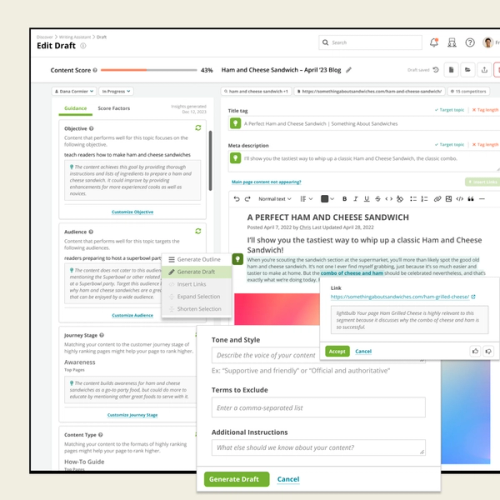
These insights help ensure content answers relevant questions clearly and covers supporting entities that AI systems often reference.
Monitor AI Overview visibility and competitive positioning
Understanding where your brand appears in AI-generated results, and where competitors appear instead, reveals where your strategy is working and where gaps exist.
Competitor Research Tracking allows teams to:
- Monitor AI Overview visibility across prompts and topics
- Distinguish between brand mentions and website citations
- Filter results by branded and unbranded prompts for more accurate competitive analysis
- Analyze which competitor domains appear most often in AI-generated answers
These insights highlight where stronger coverage or deeper expertise may be needed.
Track brand sentiment in AI-generated responses
AI-generated answers increasingly shape how brands are described and interpreted in search. Sentiment analysis within Conductor makes it possible to:
- Identify whether brand mentions appear positively or negatively
- Monitor shifts in brand perception across AI responses
- Inform digital PR and brand reputation strategies
This visibility helps teams respond quickly if messaging or perception begins to shift.
Measure AI and organic performance together
AI visibility doesn’t exist in a vacuum. To understand its real impact, you need to see how AI-generated answers influence impressions, clicks, and engagement across your broader search performance.
A unified dashboard combines:
- AI search visibility
- Google Search Console metrics such as impressions, clicks, and CTR
- SEO and analytics data
Bringing these signals together in Workspaces helps teams understand how AI-generated results influence traffic, engagement, and overall search performance.
Maintain content agility with ongoing monitoring
AI search results evolve quickly as models recrawl content, update answers, and incorporate new sources. Continuous monitoring helps you catch issues early and identify when content needs to be refreshed to maintain visibility.
With 24/7 monitoring and real-time alerting, teams can:
- Detect technical SEO issues that may impact AI visibility
- Ensure schema markup remains valid
- Track AI bot crawling activity
- Flag outdated or underperforming pages that may need updates
These signals help prioritize refreshes that keep content relevant and competitive.
Expand coverage across markets and AI platforms
AI-generated results can vary widely across countries, prompts, and AI engines. Conductor enables teams to track AI visibility across multiple markets and platforms, like ChatGPT, Perplexity, and Google AI experiences, so you can see where your content is influencing answers and where competitors are gaining ground.
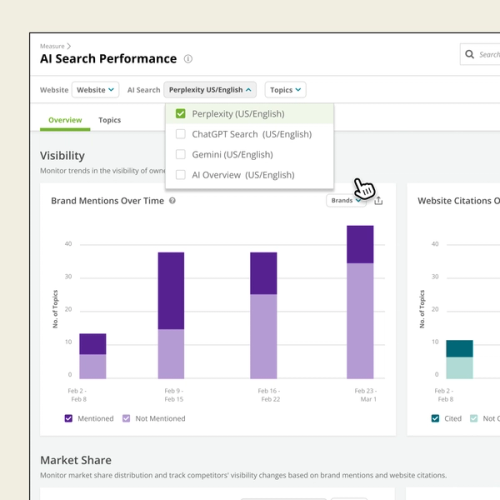
You can expand tracking within the platform to include:
- Multiple countries and markets
- Different AI engines and search experiences
- Prompts aligned to specific personas or audience segments
This broader view helps reveal where your content appears in AI-generated answers and where new optimization opportunities exist.
Optimizing for AI Overviews in summary
AI-powered search is changing how information is surfaced, synthesized, and trusted. As AI Overviews and other generative experiences evolve, the content that stands out won't just be well-optimized; it will be genuinely useful.
That means going beyond surface-level advice. The pages most likely to be cited are the ones that add something new: original insights, real-world experience, and clearly structured explanations that help users understand a topic more completely.
For content teams, the opportunity is clear. Instead of simply competing for rankingsRankings
Rankings in SEO refers to a website’s position in the search engine results page.
Learn more, focus on becoming the source that AI systems rely on when they assemble answers.